
God Alone Suffices
Communing with the Mystics, pt. 3

Let nothing disturb you,
Let nothing frighten you,
All things are passing away:
God never changes.
Patience obtains all things.
Whoever has God lacks nothing;
God alone suffices.
- St. Teresa of Avila
It takes a lot to be named the first female “Doctor” of the Catholic Church, a famously male-dominated institution.
Teresa of Avila—also known as Teresa de Jesus—did that and more.
A devoted leader of the Counter-Reformation and proponent of austerity amongst the religiously devoted, Teresa’s impact on the Catholic Church is impossible to ignore. But her story is more nuanced than just that of a devoted Catholic. Her early years point to the religious violence of late medieval Catholicism, and her opus of writings transcends organized religion altogether.
Through her prolific writing, Teresa of Avila helps us question the very nature of religion and our relationship with God within it.
Teresa Sánchez de Cepeda Dávila y Ahumada was born in Avila or possibly Gotarrendura, Spain in 1515. Her family was Christian at the time of her birth, but just a few decades before, her Jewish grandfather had been forced to convert in the wake of the Spanish Inquisition. Some accounts say that he attempted to return to Judaism, much to his peril in the eyes of the royal court, but later agreed to reassume his Catholic identity. Regardless, Teresa’s father clearly learned from his own father’s trials and raised his children to be exceedingly devout Catholics.
So devoted was young Teresa that she and her brother attempted to run away from home and seek martyrdom through fighting the Moors as children. They were apprehended by their uncle and returned home a short time later. But Teresa’s longing for religious life never waned. When she was fourteen, her mother died, and Teresa turned to Jesus’ mother, Mary of Nazareth, as her comfort, beginning her lifelong adoration of the Blessed Virgin. After her mother’s death, Teresa’s father sent her to a school run by Augustinian nuns to complete her education.
Teresa entered religious life at the age of twenty, initially joining an extremely lax Carmelite order. Appalled by the loose atmosphere in her new community, Teresa became zealous about fleshly mortification to atone for the sins of her sisters. This would lead to an extended illness, which would incite the visions that would come to define her religious vocation.
Through her visions and bouts of religious ecstasy, Teresa came to understand different levels of spiritual development, which correlated to degrees of closeness to God. These visions would go on to shape her books The Way of Perfection and Interior Castle. She also wrote her autobiography, in part as a response to her detractors who thought her visions may come from demons rather than God.
Teresa was an influential voice in the Counter Reform movement of the Catholic church, which sought to reclaim the heart of the Catholic church from laxity and apathy, as Protestantism began to flourish. She was especially interested in monastic reforms such as refocusing on poverty and preserving the sanctity of religious communities from lay visitors, who freely came and went from some cloisters in those days. She felt that religious communities should set the standard for Christian life and spent several years traveling Spain, founding new religious orders in that image.
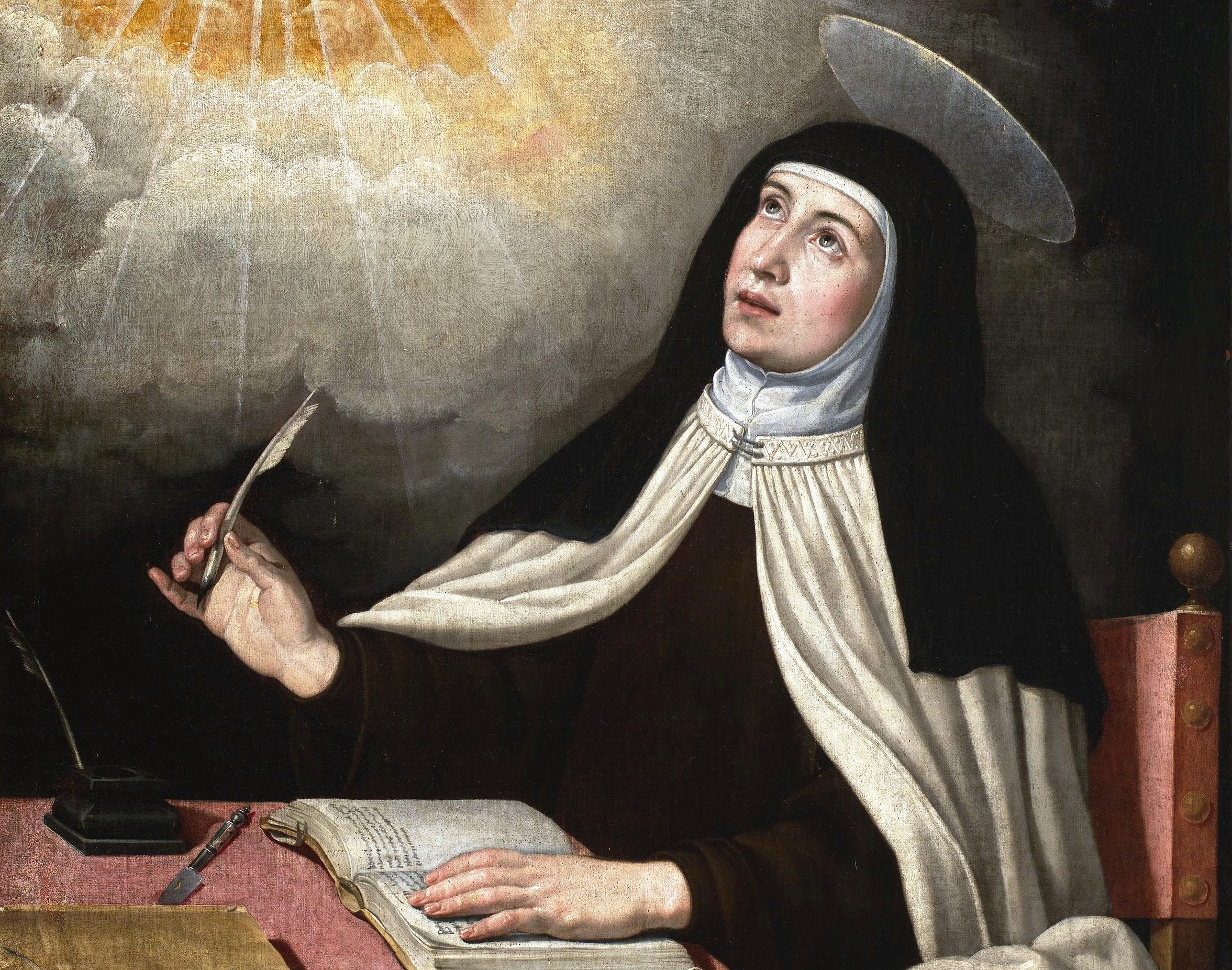
Tales of Teresa’s remarkable spiritual ecstasies are truly captivating. She would often write while gazing heavenward for hours, never looking at her pen and paper, but preserving her visions in exquisite detail. Her sisters in her order said that she was prone to levitation during her visions, which caused her a great deal of embarrassment, prompting her to ask her sisters to hold her down, lest she be carried away by the Spirit.
Teresa died during an unusual period in history, the switch from the Julian to Gregorian calendar, in which October 5th through 14th were deleted to align the dates. So she died on either the 4th or 15th of October in 1582. Some have said that, even in death, she did things her own way.
Teresa was canonized as a saint forty years after her death and was survived by her vivid and poetic writing. Many have noted that her mystical visions echo the images of other religions traditions, with journeys through seven realms and direct experience of the Divine. While Christina in her language, she is not explicitly Christian in her theology, with no great rumination on Jesus’ life and death, but rather on each soul’s personal journey. Teresa wanted nothing more than for each believer to grow closer and closer to God.
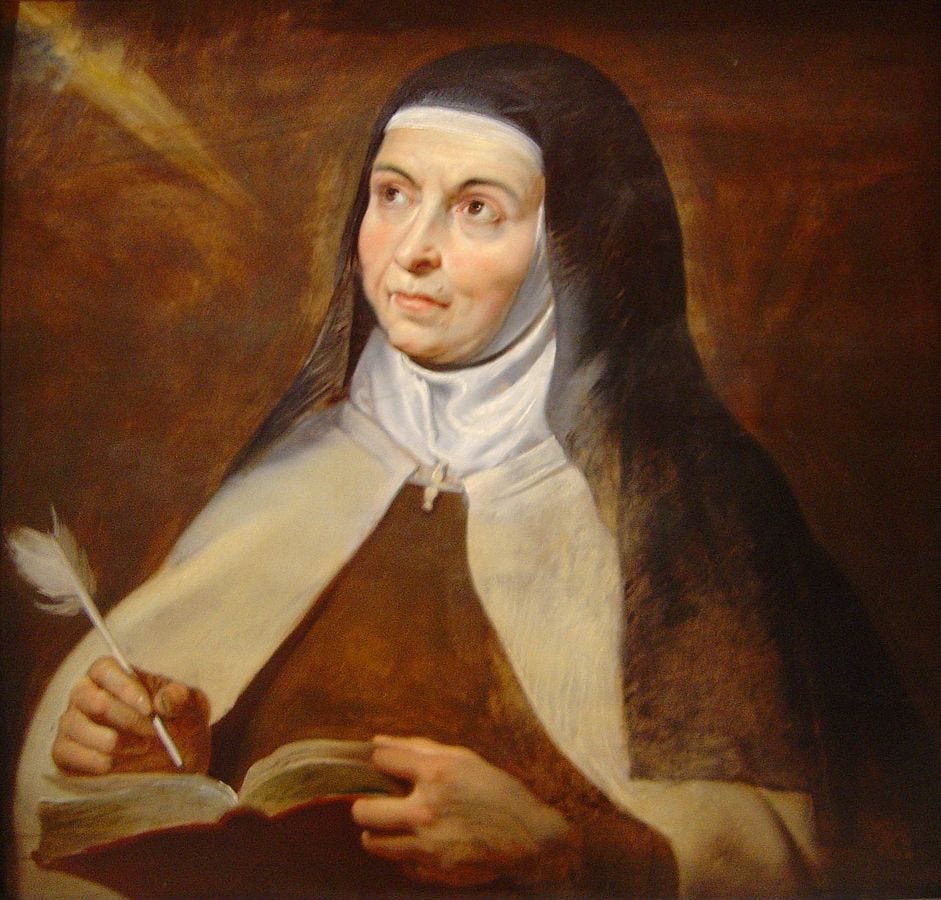
Teresa of Avila was a unique mix of spiritual tradition for her time: Jewish by heritage, devoutly Christian in vocation and practice, non-religiously mystical in her theology. Unlike her mystical forebears like Julian of Norwich and Margery Kempe, she did not fixate on orthodox religious themes such as Christ’s passion, but rather on the relationship each individual has with God. For this reason, it’s a wonder she was one of the few canonized female mystics. And yet, it is perhaps extremely appropriate for a dedicated reformer to challenge orthodoxy itself while trying to return the Church to its original values.
St. Teresa of Avila reminds us of the necessary balance of fearless faith and an open heart as the path to a relationship with the Divine.
Thank you for reading! This Wednesday, look for a special post to celebrate the Feast Day of St. Mary Magdalene. And next week, we’ll wrap up our Mystics series with one of the originals, Hildegard of Bingen. Join is for all of that!
Learned so much, ty.🩷
I love her 😭😭😭